

Starting resistance training can feel confusing when you see complicated workout splits, advanced exercises, and conflicting advice about sets, reps, and weights. The good news is that beginners do not need a complicated program to start building muscle. A well-structured muscle building workout for beginners can be simple, repeatable, and focused on learning the basic movement patterns while gradually becoming stronger.
A beginner muscle-building workout uses resistance exercises to challenge your muscles and provide a training stimulus. Over time, your body adapts to that stimulus when you train consistently and allow enough recovery between sessions. The goal is not to lift the heaviest weight possible on your first day. Instead, focus on good technique, manageable training volume, appropriate resistance, and gradual progress. A Muscle Building Workout for Beginners should therefore prioritize simple exercises and steady progress rather than advanced training methods.
This type of training can suit adults who are new to resistance training or returning after a long break. If you have a medical condition, significant injury, or other health concern, consider speaking with a qualified healthcare professional before beginning a new exercise program.
How Muscle-Building Workouts Work
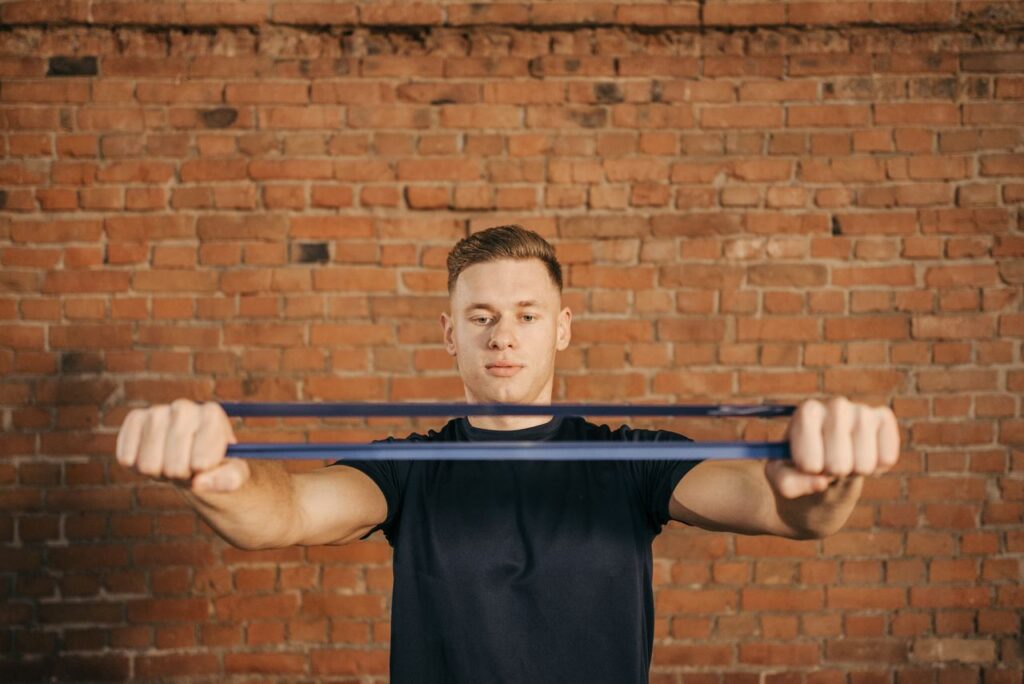
Resistance Training Creates a Muscle-Building Stimulus
Resistance training challenges your muscles by making them work against an external resistance. This is the foundation of a Muscle Building Workout for Beginners, regardless of whether you train at home or in a gym.
That resistance can come from dumbbells, barbells, machines, resistance bands, cables, or your own body weight.
When the resistance is appropriate and the exercise is performed correctly, the targeted muscles have to produce force. Repeated training provides a stimulus that can contribute to muscular adaptation.
Your Muscles Adapt to Repeated Training
Your first few workouts may feel unfamiliar because your body is learning new movements. As you practice consistently, you can become more efficient at performing those movements and gradually handle more training.
Muscle growth is not produced by one workout. It develops through repeated training over time, supported by appropriate recovery and nutrition.
Why Consistency Matters More Than a Perfect Workout
A simple workout that you can perform consistently is generally more useful than a complicated routine that you abandon after a few weeks. The same principle applies to a Muscle Building Workout for Beginners because consistent practice helps you learn exercises and track gradual improvements.
For beginners, consistency means following a manageable schedule, practicing the same basic movements long enough to learn them, and gradually improving rather than constantly searching for a new routine.
Why Muscles Need Recovery Between Workouts
Training provides the stimulus, but you also need time between sessions. This is one reason a beginner does not need to train the same muscles hard every day.
Your workout schedule should give the muscles you train enough time before they are challenged heavily again.
How Beginners Should Start Muscle-Building Training
Before starting a Muscle Building Workout for Beginners, decide how many days you can realistically train each week.
How Many Days Per Week Should a Beginner Train?
For many beginners, three resistance-training sessions per week are a practical starting point. This frequency works well for a Muscle Building Workout for Beginners because it provides regular training exposure while leaving recovery days between sessions.
For example:
- Monday — Workout A
- Wednesday — Workout B
- Friday — Workout A
The following week, switch the order:
- Monday — Workout B
- Wednesday — Workout A
- Friday — Workout B
Beginners who can only train twice per week can still use full-body workouts. Those with more available time can eventually move to a different schedule, but more training days are not automatically better.
Should Beginners Use Full-Body or Split Workouts?
A full-body routine trains several major muscle groups during each session. For this reason, a full-body Muscle Building Workout for Beginners can be easier to organize than a complex split routine. This makes it particularly practical for beginners because you can practice important movements multiple times during the week without needing a complicated body-part split.
More advanced lifters may use upper/lower or other specialized splits, but beginners generally do not need to divide their training into many separate muscle-specific days.
How Long Should a Beginner Workout Last?
A useful beginner session may take roughly 45–75 minutes, depending on the number of exercises, warm-up, rest periods, and individual pace.
Do not judge the quality of a workout only by its duration. Five focused exercises performed with good technique can be more useful than spending two hours in the gym without a clear plan.
Start With a Manageable Training Level
Your first priority should be learning the movements and establishing a sustainable routine.
Avoid the temptation to copy the workload of an experienced lifter. Start with manageable resistance and volume, then adjust as your technique and training experience improve.
Best Exercise Types for a Beginner Muscle-Building Workout

The exercises below can be combined into a practical Muscle Building Workout for Beginners without requiring an advanced training split.
Compound Exercises
Compound exercises involve multiple joints and muscle groups. They allow beginners to train several important movement patterns efficiently.
Examples include:
- Squat variations
- Romanian deadlifts
- Bench presses
- Dumbbell presses
- Rows
- Lat pulldowns
- Overhead presses
These exercises can form the foundation of a beginner workout. Together, they provide many of the basic movements needed in a Muscle Building Workout for Beginners.
Isolation Exercises
Isolation exercises place more emphasis on a particular muscle or smaller movement.
Examples include:
- Biceps curls
- Triceps extensions
- Lateral raises
- Leg curls
- Calf raises
They can complement compound exercises without needing to dominate the workout.
Push, Pull, Legs, and Core
You will often see exercises categorized as push, pull, legs, or core.
Push exercises include movements such as presses.
Pull exercises include rows and pulldowns.
Leg exercises include squats, leg presses, lunges, and hip-hinge movements.
Core exercises train muscles that help stabilize and move the trunk.
Beginners do not need a complicated push-pull-legs program to use these categories. They are mainly useful for making sure your workout includes balanced movement patterns.
How Beginners Should Choose Exercises
Choose exercises that:
- Train important movement patterns
- You can perform with controlled technique
- Allow you to use an appropriate resistance
- Fit the equipment you have available
- Can be progressed over time
If one exercise causes discomfort or you cannot perform it with reasonable control, a suitable variation may be more appropriate.
Sets, Reps, Rest, Volume, and Intensity for Beginners

This is where many beginners become unnecessarily confused. Understanding these basics makes it easier to follow a Muscle Building Workout for Beginners without constantly changing your routine.
How Many Reps Should Beginners Do?
There is no single magical repetition number for muscle growth. A Muscle Building Workout for Beginners should use a repetition range that allows you to challenge the muscles while maintaining controlled technique.
A practical beginner range for many exercises is roughly 8–12 repetitions per set, while some exercises can comfortably use higher ranges such as 10–15 repetitions. Current resistance-training guidance from the American College of Sports Medicine also emphasizes that training prescription should be adjusted according to the individual’s goals, training status, and desired adaptations.
The important point is that the resistance should be challenging enough to make the final repetitions require effort while allowing you to maintain good technique.
How Many Sets Should Beginners Do?
Starting with around 2–3 working sets per exercise is a practical approach.
Beginners should not assume that adding more sets automatically produces better results. Training volume can be increased later when there is a clear reason to do so.
How Much Rest Should You Take?
For demanding compound exercises, roughly 2 minutes or sometimes longer may be useful when you need it to maintain performance.
For smaller isolation exercises, roughly 60–90 seconds may often be sufficient.
Your rest period does not have to be exactly the same every session. If you are still breathing heavily or your technique would suffer, take additional time.
How Much Weight Should a Beginner Lift?
There is no universal starting weight because strength differs significantly between people.
Choose a resistance that allows you to complete your planned repetitions with controlled technique. The final repetitions should feel challenging, but you should not need to sacrifice form simply to complete them.
A useful process is:
Start light → practice the movement → assess technique → complete your planned reps → adjust gradually.
What Does Training Intensity Mean?
In everyday gym language, intensity often means how hard an exercise feels or how heavy the resistance is.
For beginners, avoid interpreting “high intensity” as “lift the heaviest possible weight.” A challenging set performed with good technique is more useful than a heavy set where control breaks down.
What Is Training Volume?
Training volume broadly describes the amount of work performed during training. Sets, repetitions, and resistance all contribute to the overall workload.
Beginners should focus less on calculating complicated formulas and more on performing a manageable amount of quality work consistently.
How to Structure a Muscle Building Workout
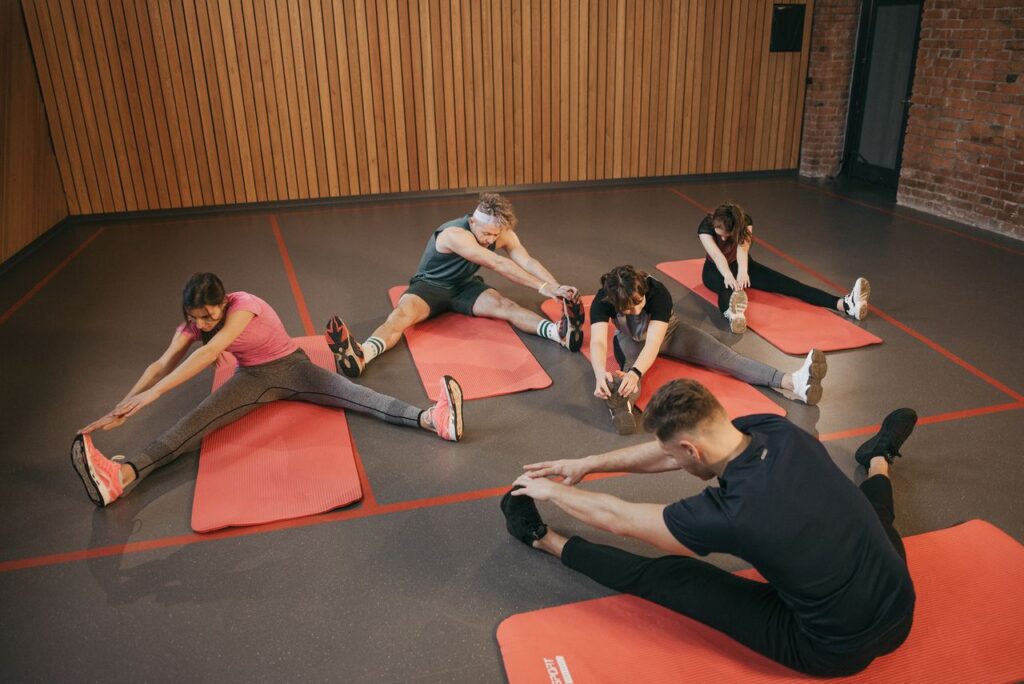
Step 1 — Warm Up
Begin with several minutes of general movement followed by preparation for the exercises you are about to perform. This basic structure can be used to organize a Muscle Building Workout for Beginners from the warm-up through the final exercise.
For example, before a squat-based workout, you can perform lighter practice sets of the movement before your working sets.
The goal is to prepare for training rather than exhaust yourself before the main workout.
Step 2 — Start With Major Exercises
Place demanding exercises earlier in the session when you have more energy and concentration.
A workout might begin with a squat or leg press, followed by a pressing movement and a pulling movement.
Step 3 — Add Supporting Exercises
After the major movements, add smaller exercises that target specific muscles or movement patterns.
For example, lateral raises, curls, or triceps exercises can come after the main compound movements.
Step 4 — Add Core Training
Core exercises can be placed toward the end of the session so they do not unnecessarily fatigue your trunk before demanding exercises.
Step 5 — Cool Down
Finish the session and allow your breathing to return toward normal. A cool-down can be simple; you do not need an elaborate routine.
Example Workout Structure
A simple session can look like:
Warm-up → Main lower-body exercise → Main push → Main pull → Supporting exercise → Core → Finish
This sequence gives a Muscle Building Workout for Beginners a clear flow without requiring unnecessary exercises. This structure provides organization without making the workout unnecessarily complicated.
Beginner Muscle Building Workout Plan

The following plan uses three full-body training sessions each week. This Muscle Building Workout for Beginners uses a simple A/B rotation so you can train consistently while practicing the major movement patterns. It is designed to give beginners a clear starting point while leaving room for technique practice and gradual progression. Use the following schedule as a starting framework for your Muscle Building Workout for Beginners.
Recommended Weekly Schedule
Week 1
| Day | Training |
|---|---|
| Monday | Full-Body Workout A |
| Tuesday | Rest |
| Wednesday | Full-Body Workout B |
| Thursday | Rest |
| Friday | Full-Body Workout A |
| Saturday | Rest |
| Sunday | Rest |
Week 2
| Day | Training |
|---|---|
| Monday | Full-Body Workout B |
| Tuesday | Rest |
| Wednesday | Full-Body Workout A |
| Thursday | Rest |
| Friday | Full-Body Workout B |
| Saturday | Rest |
| Sunday | Rest |
This A/B rotation keeps the weekly workload balanced.
Full-Body Workout A
| Exercise | Sets | Reps | Rest |
|---|---|---|---|
| Squat variation | 2–3 | 8–12 | ~2 min |
| Bench press or push-up | 2–3 | 8–12 | ~2 min |
| Row variation | 2–3 | 8–12 | ~2 min |
| Romanian deadlift | 2 | 8–12 | ~2 min |
| Lateral raise | 2 | 10–15 | 60–90 sec |
| Core exercise | 2 | 8–15 | 60–90 sec |
Beginner modifications:
- Squat → bodyweight squat, box squat, or goblet squat
- Bench press → machine chest press or incline push-up
- Row → machine row or supported dumbbell row
- Romanian deadlift → lighter dumbbell Romanian deadlift
- Core → a simple controlled core movement
These modifications make the Muscle Building Workout for Beginners more accessible when standard exercises feel too difficult at first.
Full-Body Workout B
| Exercise | Sets | Reps | Rest |
|---|---|---|---|
| Leg press or squat variation | 2–3 | 8–12 | ~2 min |
| Lat pulldown | 2–3 | 8–12 | ~2 min |
| Dumbbell press | 2–3 | 8–12 | ~2 min |
| Hip-hinge variation | 2 | 8–12 | ~2 min |
| Biceps curl | 2 | 10–15 | 60–90 sec |
| Triceps exercise | 2 | 10–15 | 60–90 sec |
Once the weekly schedule is established, the next step is to perform the two workouts consistently as part of your Muscle Building Workout for Beginners. The exact equipment does not have to be identical to this table. The important idea is to maintain similar movement patterns.
This flexibility allows you to keep following your Muscle Building Workout for Beginners even when your gym equipment or training environment changes.
For example:
Lat pulldown → assisted pull-up
Dumbbell press → machine chest press
Biceps curl → cable curl
Triceps extension → cable pressdown
What If You Can Only Train Two Days?
Perform a full-body workout on both days.
For example:
- Monday — Workout A
- Thursday — Workout B
You do not need to cram the missed third session into another day.
What If You Can Train Four Days?
Avoid simply doubling every exercise.
A beginner can distribute training across four days, but the additional day should not automatically mean twice the training volume. If you are still learning basic movements, keeping the workload manageable is more important than filling every available training day.
How Beginners Should Progress Their Workouts

Beginner progression should be simple. You do not need advanced programming techniques. The goal is to gradually make your Muscle Building Workout for Beginners more challenging as your ability improves.
When Should You Increase the Weight?
Consider increasing resistance when you can consistently complete the upper end of your planned repetition range with good technique and the current resistance no longer provides an appropriate challenge.
Make small increases rather than making large jumps. This approach keeps your Muscle Building Workout for Beginners manageable while still allowing you to build strength over time.
Add Reps Before Adding More Weight
For example, if your target range is 8–12 repetitions, you might initially perform 8 repetitions.
As you become more capable, you could gradually work toward 9, 10, 11, and eventually 12 repetitions.
Once the movement is controlled at that level, a small increase in resistance may be appropriate.
Improve Technique Before Increasing Resistance
If increasing the weight causes you to:
- Swing the weight
- Shorten the movement unnecessarily
- Lose control
- Change your body position significantly
- Depend on momentum
then the resistance may have increased too quickly.
The linked article can provide a deeper explanation of systematic progression without making this beginner guide overly advanced. For a step-by-step breakdown of how to gradually challenge your muscles, read our detailed guide on Progressive Overload Workout.
How to Know When a Workout Is Too Easy
A workout may be too easy if you consistently finish every set with very little effort and the planned resistance no longer challenges you.
However, “too easy” does not mean you should immediately double the weight.
First check your technique, repetition range, consistency, and whether you are actually following the planned workout.
Exercise Form and Technique for Beginners

Why Technique Matters More Than Heavy Weight
Beginners sometimes assume that heavier weights automatically produce better results.
The priority should instead be controlling the movement and using a resistance appropriate for your current ability. Good technique should remain a central part of every Muscle Building Workout for Beginners, especially while you are learning new movements.
Learn the Movement Before Loading It Heavily
If an exercise is completely new, practice the movement with little or no external resistance first when appropriate.
Then gradually introduce resistance while maintaining control.
Use a Controlled Range of Motion
Perform repetitions through a controlled range that is appropriate for the exercise and your individual mobility.
Do not shorten every repetition simply to use more weight.
Common Beginner Form Mistakes
Watch for:
- Moving too quickly
- Using momentum
- Losing control of the resistance
- Increasing weight too quickly
- Copying advanced lifting techniques without understanding them
- Allowing technique to deteriorate near the end of a set
How Beginners Can Learn Proper Technique
Use reliable instructional resources and, when available, consider guidance from a qualified fitness professional.
Start with lighter resistance and practice the movement before worrying about lifting heavy.
If you are unsure whether your technique is correct, reducing the weight and reviewing the movement is usually more productive than simply pushing through poor repetitions.
Training Frequency and Recovery for Beginners
How Often Should Beginners Train Each Muscle Group?
A full-body routine performed around three times per week provides regular exposure to major muscle groups while leaving rest days between sessions. Research on resistance-training dose also shows that weekly training volume and frequency are important variables to consider when planning a muscle-building program. This makes recovery an important part of any Muscle Building Workout for Beginners rather than something to consider only after training.
You do not need to train every muscle every day.
Why Rest Days Matter
Rest days allow you to return to the next workout with enough capacity to perform the planned exercises effectively. This is particularly important when you are new to resistance training and your body is still adapting to the workload.
How to Space Full-Body Workouts
A simple pattern is:
Train → Rest → Train → Rest → Train
This provides a straightforward structure for beginners.
Signs You May Need More Recovery
Pay attention if you experience persistent excessive soreness, declining performance, unusual fatigue, or difficulty maintaining normal exercise technique.
If your performance is repeatedly declining, review your training volume and schedule rather than automatically adding more work.
Common Beginner Muscle-Building Workout Mistakes
Avoiding these mistakes can help you get more from your Muscle Building Workout for Beginners without unnecessarily increasing your training workload.
Doing Too Much Too Soon
Starting with an excessive number of exercises, sets, or training days can make the routine difficult to sustain.
Constantly Changing Your Workout
Changing exercises every few days makes it harder to learn movements and track progress.
Give a sensible routine enough time to become familiar.
Ignoring Exercise Technique
Getting through a set is not the same as performing it well. Technique should remain a priority.
Using More Weight Than You Can Control
If you need momentum or major changes in body position to complete repetitions, the resistance may be too high.
Not Tracking Sets, Reps, and Weight
Without basic records, it becomes difficult to know whether you are actually progressing.
Skipping Major Muscle Groups
A beginner program should include the major movement patterns rather than focusing exclusively on visible muscles such as the chest or arms.
Taking Too Little Recovery
More training is not automatically better. Your schedule should allow you to perform subsequent workouts effectively.
Expecting Instant Results
Muscle development takes time. Early strength improvements can also come from becoming more familiar and efficient with the exercises.
Training Inconsistently
Missing occasional workouts is normal. The problem is allowing missed sessions to become a long-term pattern.
How to Track Your Workout Progress
What Beginners Should Record
A simple workout log can include:
- Exercise
- Weight or resistance
- Sets
- Repetitions
- Workout date
- Training frequency
You can use a notebook, spreadsheet, or workout-tracking application.
How to Recognize Progress
Progress is not limited to seeing a larger number on the scale.
You may notice:
- More repetitions with the same resistance
- More resistance with similar technique
- Better control
- Improved range of motion
- Progressing to a harder exercise variation
- More consistent training
What to Do When Progress Stalls
If your numbers stop improving, do not immediately replace the entire program.
First review your exercise technique, consistency, training schedule, recovery, and whether you have actually reached a sustained plateau.
A dedicated progression guide can go deeper into what to do when normal beginner progress slows.
How to Make Your Beginner Workout Routine Sustainable
Build Your Workout Around Your Schedule
Choose training days that realistically fit your work, school, family, and other responsibilities.
A routine that fits your life is easier to repeat.
Choose a Routine You Can Repeat
You do not need to perform every exercise you see online.
A smaller number of well-chosen movements can give you a clear structure.
Don’t Depend Entirely on Motivation
Motivation changes. A scheduled workout is easier to follow when it becomes part of your normal routine.
Avoid Burnout From Doing Too Much
More exercises, more sets, and more training days are not automatically necessary.
Start with a manageable workload and allow your training capacity to develop.
What to Do When You Miss a Workout
If you miss one session, return to your normal schedule rather than trying to squeeze multiple demanding workouts into one day.
Long-term consistency matters more than perfectly completing every single planned session.
Beginner Muscle Building Workout FAQ
How many days a week should a beginner workout to build muscle?
For many beginners, three resistance-training sessions per week provide a practical starting structure. Two full-body sessions can also work when time is limited. A Muscle Building Workout for Beginners can also be adjusted to two weekly sessions when your schedule is limited.
What is the best workout for beginners to build muscle?
A simple full-body resistance-training routine that covers major muscle groups and movement patterns is a practical starting point. The best routine is one you can perform consistently with appropriate technique and resistance.
Can beginners build muscle with full-body workouts?
Yes. Full-body workouts allow beginners to train multiple major muscle groups during each session and can be particularly convenient when training two or three days per week.
How many sets and reps should beginners do for muscle growth?
A practical starting point is often around 2–3 working sets per exercise, with many exercises performed for roughly 8–12 repetitions. Some movements can use higher repetition ranges.
How much weight should a beginner lift?
Use a resistance that allows you to complete your planned repetitions with controlled technique. There is no single starting weight that applies to every beginner.
How long should a beginner muscle-building workout last?
Many beginner sessions can fit into roughly 45–75 minutes. The exact duration depends on the exercises, warm-up, rest periods, and individual pace.
How often should beginners train each muscle?
A full-body routine can train major muscle groups multiple times per week while providing rest days between sessions. The exact frequency should fit the person’s training experience and total workload.
Can I build muscle with bodyweight exercises?
Yes. Bodyweight exercises can provide meaningful resistance, particularly when the exercise is appropriately challenging. Beginners can also progress by using harder variations or eventually adding external resistance.
Should beginners train to failure?
Beginners generally do not need to take every set to complete muscular failure. Learning good technique and performing challenging but controlled repetitions is a more practical starting approach.
Can beginners do cardio while building muscle?
Yes. Cardio can coexist with resistance training. For beginners, the main consideration is organizing the overall workload so cardio does not interfere with the ability to complete resistance workouts effectively.
What should I do if I am sore after a workout?
Some muscle soreness can occur when beginning resistance training, especially after unfamiliar exercise. Give your body appropriate recovery and avoid forcing another demanding session when you cannot perform movements safely or effectively.
How long does it take to see progress from beginner strength training?
Progress varies between individuals and depends on factors such as training consistency, exercise selection, starting experience, nutrition, and recovery. Avoid judging the program based on a specific promised timeline.
Conclusion: Start Your Muscle Building Workout With a Simple Plan
A successful muscle building workout for beginners does not need to be complicated. Start with a manageable number of training days, learn the basic movement patterns, use appropriate resistance, and focus on controlled technique.
A simple full-body routine performed consistently can give beginners a strong foundation. Track your exercises, sets, reps, and resistance so you can recognize progress over time. When the current workload becomes manageable, gradually increase the challenge rather than making large changes all at once.
Most importantly, don’t try to make your first month look like an advanced lifter’s program. Your goal is to build the skills, strength, consistency, and training habits that will support future progress.